
Two header beams
The pipe hangers typically hang from a pair of headers. They carry the lift and the boat between them, and plenty of older boathouses here were framed to hold up a roof rather than a roof and a boat.
While you are still shopping
The lift that comes with a house on this lake is usually twenty to twenty-five years old, and it was set up for the boat of its day. None of that means anything is wrong with it. It means four things decide whether it suits the boat you are looking at, and all four are cheaper to settle while the boat is still somebody else’s.
Calls and texts both reach us.
Most people arrive at this the other way round. They settle on a boat, and then find out what it needs. These are the four questions the boathouse is going to ask, and every one of them is a boat-shopping question rather than a delivery-day one.
None of this means anything is wrong with your lift.
It means the answers belong to your slip rather than to a page. Two boathouses a hundred feet apart can need different answers, and nothing written here can see yours — so what follows is what we would be looking at, not a verdict on what you have got.
The useful moment is while you are still choosing. Now, an answer can change which boat you buy. Afterwards it can only change what the work costs.
Dry weight is a marketing number. What the lift has to pick up is the boat with fuel in it, water in it, batteries, and the gear that lives aboard all season. That figure is what the gear plate has to be rated for, and the rating is normally stamped or plated on the plate itself.
The gap between those two numbers is the commonest reason a lift that ought to be fine is not. It is wide enough, often enough, to move a boat from comfortably inside a plate’s rating to sitting right on top of it — and it is why the answer to “will my lift take it” is never the brochure’s figure.
Then there is the part nobody connects. A heavier boat can want a bigger motor, and a bigger motor draws more current than the run out to the boathouse was sized for — twenty-odd years ago, for the motor of that era. That is a separate cost and a separate trade, and it is far better known about now than a month after the boat lands. Why a lift that worked for twenty years suddenly stalls →
Worth separating out while you are thinking about it, because it saves people buying the wrong thing: this is two decisions rather than one. The plate and the motor come from the weight. The brackets the hull actually sits on come from the type of boat — a pontoon going to a V-hull, or a pontoon going to a tritoon, changes the second, and the first is a separate question with its own answer. Brackets, risers and modifications →
Often the answer here is a motor, plate or cable upgrade on the frame that is already hanging there rather than a new lift. But which of those it is depends on what is actually out there, so we look before we price — and the number to carry into the conversation about the boat is its wet weight, alongside whatever is legible on the gear plate you already have.
Length is the slip, not the lift. A lift can be changed, upgraded, moved or replaced. The opening you back into is the building, and the building is a much larger conversation. That is the constraint people never think to check, because nearly everything written about boat lifts is written about weight.
It is also the whole boat rather than the hull. A swim platform or a pulpit hanging off the ends takes up slip, a published length does not always include them, and the lift takes its share as well.
The slip is not always the last word, and this is the one genuinely hopeful answer in the whole business. On some slips the front can be opened up to gain length. Whether that is possible on yours comes down to how deep the water is there, and depth on this lake is not a single number — it moves through the day and it moves through the year, so what you see on a summer afternoon is not what the boat has to live with. How the level moves here →
This is also the question whose answer can be a flat no, which is exactly why it belongs in front of six boats rather than in front of one. Measure the opening you would back into, get the boat’s length over everything rather than its hull length, and ask about the front of the slip rather than assuming it either way.
Lake Sinclair is a Georgia Power reservoir. They own the shoreline and set the rules for what can be built on it, and anything that changes the building — opening up the front of a slip, widening a stall, adding to the structure — needs a permit in hand before work starts rather than after. A permit for one thing is not cover for another.
We set their requirements out on one page because they are hard to find, and their published material governs rather than ours. The dock rules, as we read them →
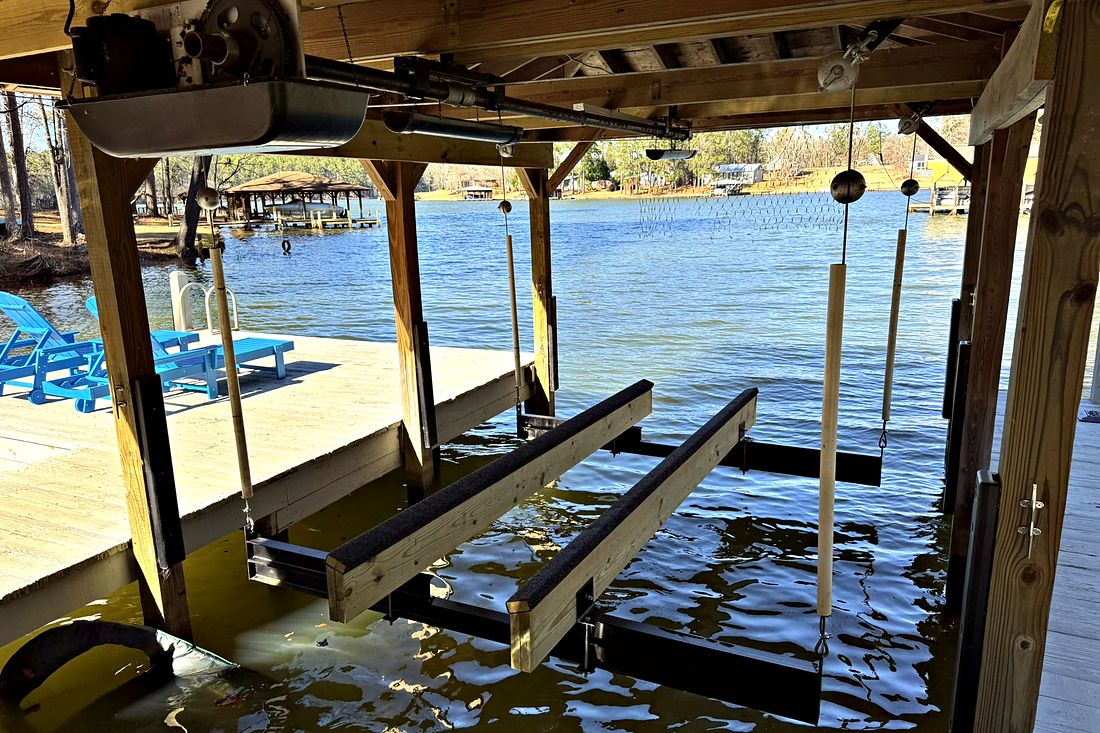
A flat-plate lift does not stand in the water on this lake. It hangs in the boathouse, which means the boathouse is carrying the boat and the lift together, in weather. Three parts of the building do that work, and people are often surprised there are three.
The pipe hangers typically hang from a pair of headers. They carry the lift and the boat between them, and plenty of older boathouses here were framed to hold up a roof rather than a roof and a boat.
The gear plate usually mounts to its own header at the front, smaller than the other two. It matters here because moving a lift is not only a question about the pair behind it.
Everything above lands on these, and what matters is whether they are sound and still plumb. Settling and leaning are real on this lake, and a structure that has moved changes what should be hung in it.
A bigger boat asks those same members a question they have not been asked before. A structure that has carried the old lift for twenty years has carried the old lift, and that is all it has proved.
So it is worth being exact about what a look at that is, because this is the part of the page most likely to be repeated back to somebody. When we look at a header beam and the posts under it, that is an experienced opinion about whether a lift belongs there. It is not an engineered load calculation and it is not a certification of your boathouse. Where we think a job needs an engineer, we say so before we quote. Where our work stops →
The heavier the boat, the more this one matters, and it is a question to raise while the boat is still somebody else’s. What this page will never be is the one that tells you the structure will take it.
This is the one nobody expects, and it is why a slip that measures long enough and a plate that is rated for the weight can still add up to work.
Older boats were smaller, and the lifts that went in for them were generally installed further forward in the slip than a bigger boat wants. Put a longer, heavier hull on a lift set for a shorter one and it is not picked up at the right weight distribution. The lift is in the wrong place for it, whatever the other numbers say.
What that takes varies, and it goes by three names: the lift may need reinstalling, it may need modifying, it may need reconfiguring. Which of the three yours would be depends on the lift, on the slip and on what it is hanging from. We are not going to pick one of them from here, and anyone who picks one off a listing photo is guessing.
So the useful posture is to assume the lift may have to move, and to be pleased if it does not. It is ordinary work rather than bad news, but it is work, and it prices far better into a boat you are still choosing than into a weekend you had planned to spend on the water.
Two habits for the first few weeks. Both are free, and both are worth more than anything that can be read.
Learn where the boat wants to sit. Too much weight toward the back makes a lift work inefficiently, and it will strain on a boat that is comfortably inside what the plate is rated for. Where a hull wants to sit depends on the hull, so it is worth a few tries to find it rather than settling for wherever it landed the first time.
Learn what right looks like now, while it is right. Watch how the lift sits with the boat on it and how it sits empty, and remember it. A lift compared against itself next season tells you more than any figure could: whether it is sitting lower than it was, and whether it sits the same on both sides.
If the boat is already parked as far forward as it will safely sit and the lift still labors, the thing to look at is the lift rather than the boat. On an older setup, wear and cable that has bunched on the drum — among other causes — can put the load out left to right as well as front to back, and no amount of moving the boat will straighten that. What that looks like from the end of the dock is a fair question, and it is one we would rather answer by looking than have anybody diagnose from a page.
One last thing, specific to a new boat. The week most people meet the motor’s run-time limit is this one — jogging the lift up and down lining up bunks under a hull nobody has lifted before. The motors we fit are rated for fifteen minutes and carry no thermal protector, so nothing cuts the power when the limit passes. Give it a rest between tries. What the run-time limit actually means →
Photographs answer more of this than a description does, and they cost a walk down to the dock and ten minutes with a phone. Daylight, wide first and then close, and numbered the way this list is so we know which is which.
Worth asking the seller while you are at it: roughly how old the lift is, when it last ran, what boat was on it, and whether the boathouse is permitted. Older boathouses on this lake were not always permitted — those exist here — and the permit is the homeowner’s to hold rather than the contractor’s, so it is much cheaper to establish now than after somebody has applied for something.
Pictures will not settle a slip on their own. That part is a measurement and a look, and how a lift behaves with a boat on it is not something any still photograph shows. What they do is tell us what we would be looking at, which is usually enough to say what is worth settling before you agree a price on the boat. There is no charge for an answer, and once there is a job to look at, an estimate on Lake Sinclair is free and there is no call-out fee.
Send the photos and the details → The questions we get asked → What decides the lift → What happens next →
General information, written out of our own work on this lake. It is not advice about your boathouse, which we have not seen. How to read this site →
Call or text and talk to someone who actually does the work. No call center, no ticket number.
That number takes texts. Prefer to write? contact@phillipsmetalworksllc.com